3D printing materials: PLA, PETG, ABS, ASA, TPU, nylon, PC, composites, flame-retardant materials and SLA resins. Tell us what your product needs to withstand.
From scale models and enclosures to load-bearing components. We select the material to suit the application, environment and finish you need.
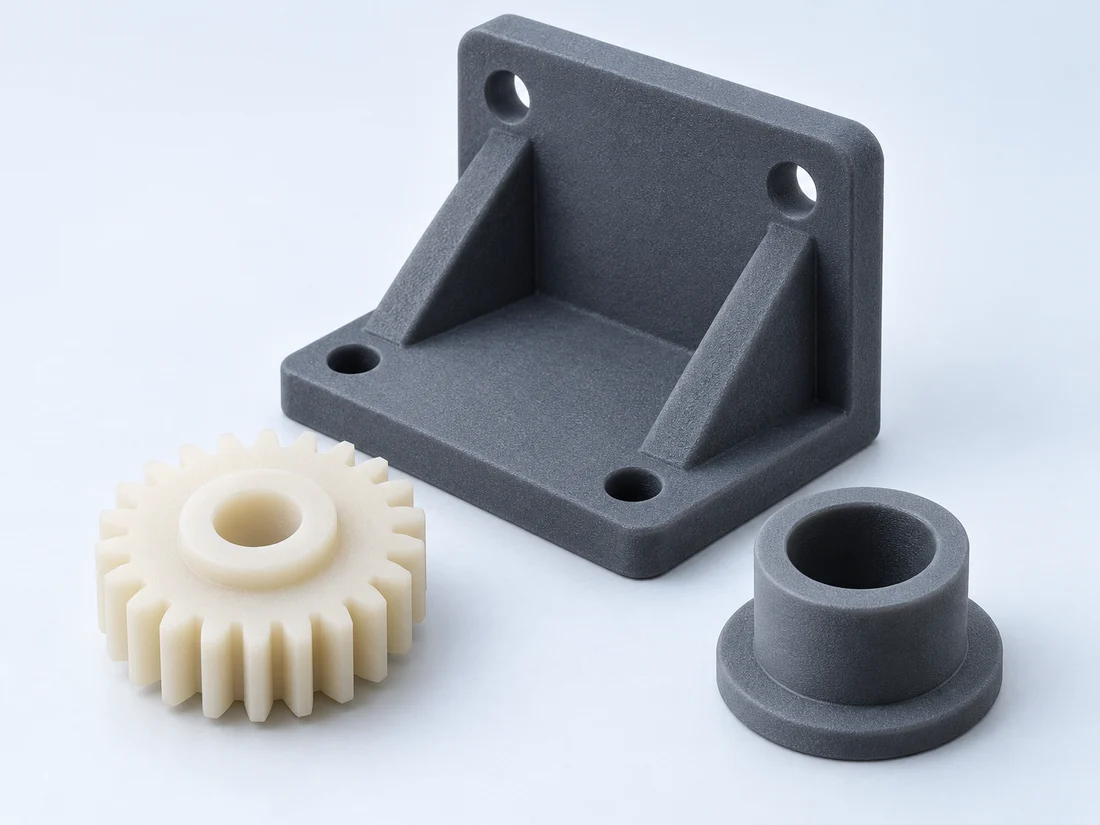
PETG and ABS are also excellent choices for mechanical components.
For many brackets, holders and enclosures, they offer the right balance of performance and printing cost. We tailor the design and print settings to the loads your part needs to withstand.
ALL MATERIALS AT A GLANCE
Compare the options. Choose with us.
A single overview of materials for FDM and SLA printing. Compare the ratings at a glance, then expand each material’s benefits and recommendations for more detail.
Printing costMore stars = higher production cost.
PropertiesMore filled bars = a higher property rating.
ABS is a very good choice for many mechanically loaded components and enclosures.
ASA offers an advantage for UV and weather exposure.
Good to know
ABS and ASA are not interchangeable in every environment. We generally consider ASA first for outdoor use and check temperature and load requirements separately.
TPU
When a part needs to flex
FDM
Edge protectors, dampers, flexible covers and grip components.
The range covers different base plastics, such as PETG-CF and PA-CF. Fibres primarily increase stiffness; heat resistance and toughness also depend on the base plastic.
Benefits and recommendations
Advantages
CF means carbon fibre; GF means glass fibre.
Fibres can increase stiffness and change the behaviour of the base material.
Good to know
PA-CF and PETG-CF are different materials. Greater stiffness does not necessarily mean greater toughness or equal strength in all directions.
FR materials
Flame-retardant materials
FDM / SLA
Electronic enclosures and parts with specified flammability requirements.
The range covers different flame-retardant filaments and resins. FR describes their response to fire, rather than identical heat resistance or mechanical properties.
Benefits and recommendations
Advantages
Materials with a documented flammability classification can be selected.
Filament and resin formulations are available for different requirements.
Good to know
FR does not mean non-combustible. A material classification does not automatically certify the finished product; wall thickness, process and the required standard matter.
Standard resins
Appearance and fine detail
SLA
Presentation models, small details and visual prototypes.
From flexible and tough to rigid or heat-resistant resins. The range represents different resin types; no single resin has all the highest ratings at once.
Benefits and recommendations
Advantages
Tough, flexible, heat-resistant and other specialist formulations.
Selected for the load and required behaviour of the part.
Good to know
An ‘ABS-like’ label does not mean the same composition as ABS filament. We consider the technical data sheet, correct curing and the operating environment.
UNDERSTANDING MATERIAL PROPERTIES
What does each rating tell you?
Ratings from 1 to 5 compare typical material behaviour. A higher rating is not always a better fit: a flexible protective part, for example, needs less stiffness than a bracket.
Printing cost
The relative cost of producing a comparable part. More stars mean more expensive printing. This includes preparation, production time and finishing, rather than just raw material cost.
Toughness
How well a material withstands impact and deformation before breaking. Important for holders, clips and parts that may be knocked or dropped.
Hardness
How well a surface resists indentation. For TPU, a Shore hardness rating helps describe how soft it feels.
Heat resistance
How it retains shape and useful properties when heated. We consider exposure time and mechanical load as well as temperature.
Stiffness
How far a part bends under force. A stiff material bends less, but is not necessarily more impact-resistant.
Wear resistance and environmental exposure
For moving parts, we assess sliding contact and wear. For outdoor use, we account for sunlight, moisture and chemicals; ASA is often a suitable choice for weather-exposed parts.
How do we use the scale?
Printing cost is a comparative rating: PLA has 1 star and nylon has 5. Stars are not a price list or an automatic quote. Actual pricing also depends on the part’s shape, size, quantity and finishing.
Property ratings simplify the comparison of typical formulations; they are not measurements of your part. Material formulation, moisture, print orientation and settings affect the result. For composites, FR materials and specialist resins, ranges show the differences between formulations. We check the properties of the specific material for your part.
You do not need to choose a material in advance.
Select “Advise me” in the form. We review every model individually and recommend a material, technology and settings for its actual use.
COLOUR AND SURFACE
Appearance is part of the brief.
Tell us which surfaces will be visible, the colour you want and whether the part needs to match an existing item. On-screen colours are a guide only.
Black
White
Grey
Blue
Red
Multiple colours, built into the print.
We can combine several colours in one part for logos, lettering, accents and distinctive branded products. We agree on the options based on the model, material and technology.
Availability depends on the material.
Engineering materials may not offer the same colours as PLA. Layers may be visible in translucent parts; translucent does not mean optically clear.
Finishing matters too.
We agree on support marks, sanding, painting and the desired finish before production. For precise colour matching, we can arrange a sample.
Unsure what to choose?
Describe the purpose, temperature, loads and environment in your enquiry. We will suggest a suitable approach.